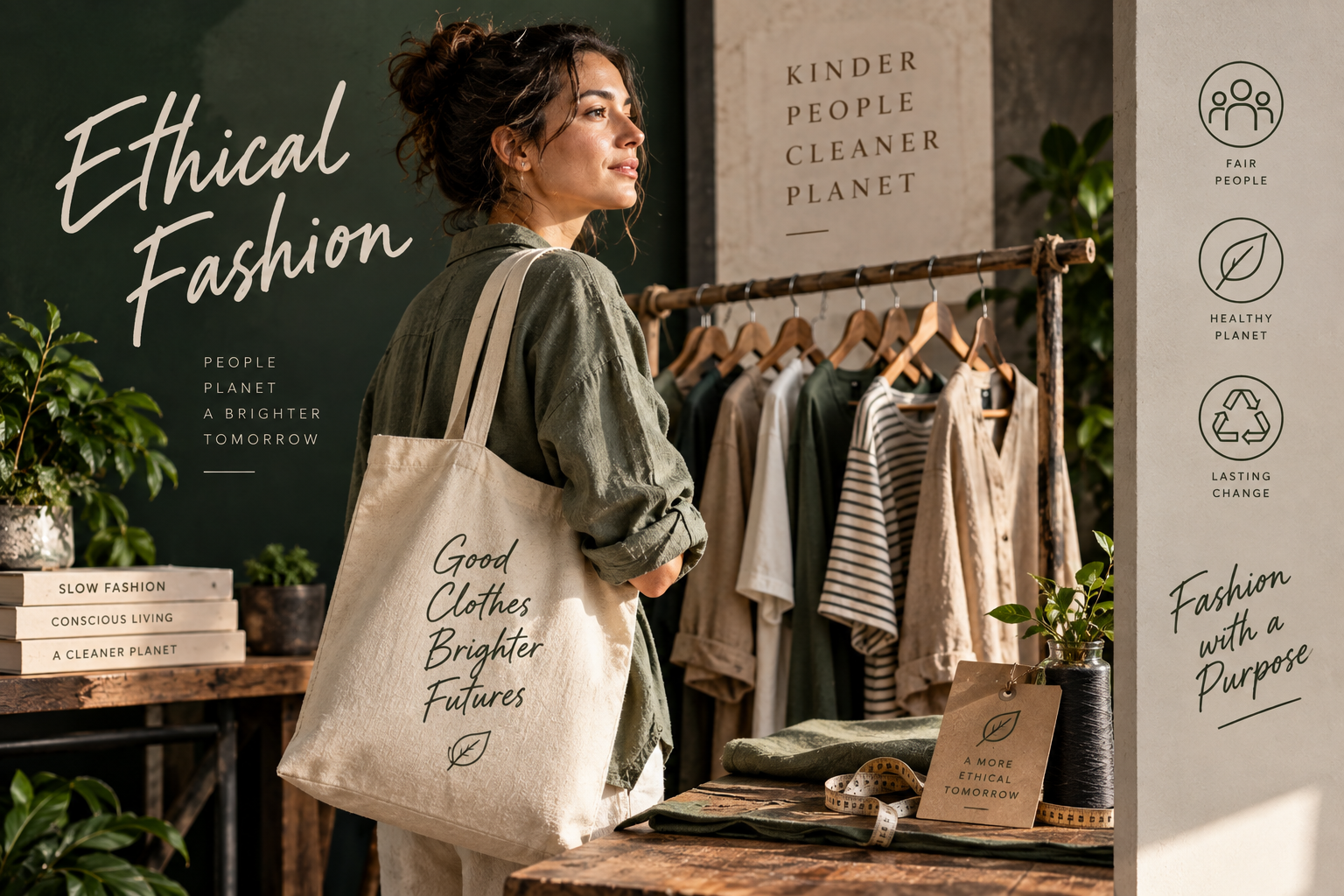
Ethical fashion has become one of the most used and least defined phrases in retail. It appears on landing pages, in press releases, and across social campaigns, often attached to nothing verifiable. Yet the underlying idea is specific and demanding: clothing produced without exploiting the people who make it or the ecosystems it draws from.
This guide separates the definition from the marketing — what ethical fashion covers, how it differs from sustainability, which credentials mean something, and how to build a wardrobe around it without spending recklessly.
What ethical fashion actually means
At its core, ethical fashion concerns the treatment of people across the supply chain. That means garment workers earning a living wage rather than a legal minimum, working reasonable hours in buildings that will not collapse, free to organise without retaliation, and not subject to forced or child labour.
It extends backwards to cotton farmers and dye house staff, and forwards to warehouse and retail workers. A brand can produce a beautiful organic garment and still fail entirely on ethics if the people who sewed it were paid poverty wages under coercion.
The distinction matters because the two ideas are routinely conflated.
Ethical versus sustainable: not the same thing
Sustainable fashion addresses environmental impact — water use, chemical load, carbon emissions, waste, biodiversity.
Ethical fashion addresses human impact — wages, safety, hours, freedom of association, dignity.
The strongest brands do both, but neither guarantees the other. Recycled polyester made in a factory with locked fire exits is environmentally motivated and ethically indefensible. Hand-woven cloth from fairly paid artisans, dyed with heavy metals dumped into a river, is the reverse.
When you evaluate a label, ask both questions separately. Companies that only answer one are usually avoiding the other.
The problems ethical fashion responds to
The modern movement gained urgency after the 2013 Rana Plaza collapse in Bangladesh, which killed more than 1,100 garment workers in a building whose structural warnings had been ignored the day before. It remains the deadliest disaster in the industry’s history and forced global brands to acknowledge conditions in factories they had long treated as someone else’s responsibility.
The structural issues behind it persist. Fast fashion’s economics depend on compressing production costs, and labour is the most compressible line item. Order volumes shift between suppliers with little notice, pushing factories toward excessive overtime and subcontracting into unmonitored workshops. Legal minimum wages in major garment-producing countries frequently sit well below a calculated living wage for the region.
None of this is solved by consumers alone. But purchasing patterns do shape which business models remain viable.
How to evaluate an ethical fashion brand
Verification beats vocabulary. These credentials involve independent auditing:
Fairtrade certifies pricing and conditions for producers, most commonly at farm level for cotton.
Fair Wear Foundation works directly with brands on labour conditions in sewing factories and publishes performance reports on its members — including their failures, which is a good sign of a serious standard.
SA8000 is an auditable workplace standard covering child labour, forced labour, health and safety, working hours, and freedom of association.
B Corp certification assesses a company’s overall social and environmental performance, governance, and transparency rather than a single product line.
GOTS is best known as an organic textile standard, but it also carries social criteria on wages, hours, and working conditions — which is why it appears in ethical discussions as well as environmental ones.
Beyond certification, look for published supplier lists. Brands that name their factories can be held accountable; brands that will not are asking for trust they have not earned. Fashion Revolution’s annual Transparency Index is a useful reference for how much major companies actually disclose. Genuinely ethical clothing brands tend to over-explain their sourcing, because the alternative is being lumped in with everyone else making unverifiable claims.
Greenwashing signals to watch for
- Percentage claims with no base. “40% more sustainable” than what, measured how?
- A single capsule collection marketed as evidence while the core business model stays untouched.
- Awards and pledges instead of audits. Signing a commitment is not the same as passing an inspection.
- Recycling take-back schemes used to justify high volume production, with no published data on what is actually recycled.
- “Ethically made” with no named factory, no certification, and no wage information.
The test is the same each time: is there a number, a named third party, or a document behind this claim?
Building an ethical wardrobe realistically
Ethical fashion has an accessibility problem, and pretending otherwise helps nobody. Certified production genuinely costs more, and not everyone can absorb that. A workable approach:
Buy less, first. The most ethical garment is the one already in your wardrobe. Extending the life of clothes you own outperforms any purchasing decision.
Buy secondhand where you can. Resale removes the production question entirely and is usually the cheapest option available.
Prioritise your highest-rotation items. If you wear the same five t-shirts constantly, that is where certified quality earns its cost per wear — not in occasion pieces worn twice a year.
Trade up gradually. Replace as things wear out rather than overhauling everything at once. Investing in eco-luxury essentials makes sense for the pieces that anchor a wardrobe for years; it makes far less sense for trend items.
Learn basic repair. A replaced button or mended seam adds years to a garment for almost nothing.
Time larger purchases. Buying certified staples during a seasonal sale is a practical way to close the price gap without compromising on standards.
Does ethical fashion cost more?
Per item, yes. A living wage, safe facilities, and independent auditing are real costs that fast fashion externalises onto workers.
Per year, often not. Better construction and better fabric mean garments survive more wash cycles and hold shape longer. Buying four shirts that last five years costs less than twenty that last one season, and the wardrobe looks better throughout.
The wider point is that the low prices on fast fashion tags are not genuinely low. Someone pays the difference — usually a worker earning below what their region requires to live. Ethical fashion is largely an argument about who absorbs that cost.
Where to start
Pick one category you buy most often and set a rule for it: certified, secondhand, or not at all. Learn the two or three certifications relevant to that category well enough to spot a fake logo. Check whether your favourite brands publish a supplier list, and notice how you feel about the ones that do not.
That is a far more durable habit than a single expensive purchase made to feel better. Ethical fashion works as a standard you apply repeatedly, not a product you buy once.